
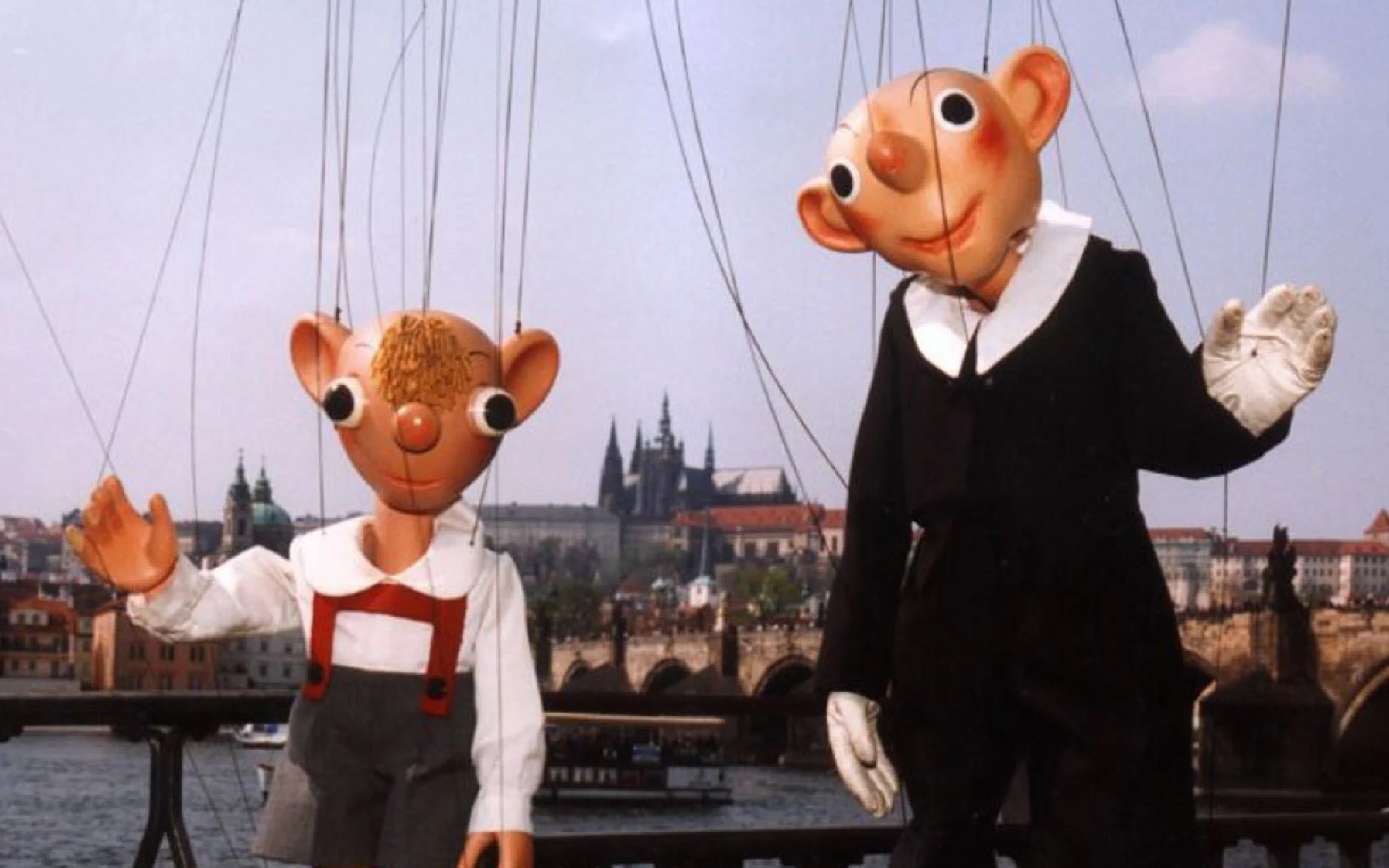
An evening featuring Spejbl and Hurvinek – the beloved marionette comedy duo from Prague, whose witty father-son banter has delighted audiences worldwide for over a century.
Puppeteer Vit Horejs will talk about the history and role of puppetry, including the Spejbl and Hurvinek Theatre and its founder Josef Skupa, against the sociopolitical backdrop of Czechoslovakia from the 1920s to today. The talk will include selected scenes performed in English, showcasing the duo’s humor and subtle voice of resistance during times of censorship and persecution.
After 1933, the Spejbl and Hurvinek Theatre faced censorship. In 1938, Skupa and Wenig wrote one of the theater's most memorable plays, The Three-Story Carousel (Kolotoc o trech poschodich), which was a bold allegory of the 1939 Munich Agreement. In 1944–1945, the founder Josef Skupa was imprisoned by the Gestapo in Dresden.
The puppet of Spejbl was sculpted by woodcarver Karel Nosek in 1920, based on Josef Skupa’s design. Conceived in the Dadaist spirit, Spejbl is dressed in a tuxedo with tails, snow-white gloves and wooden shoes; in contrast, the character is bald-headed, with large ears and protruding eyes. This opposition between different social symbols is also expressed in the puppet's personality: a simple man, clumsy, opinionated, mired in contradictions, and torn between his social ambitions and his limited capabilities. The Hurvinek puppet was carved in 1926 by Gustav Nosek. His appearance – peculiar movable eyes, a tuft of dishevelled hair, dressed in short pants held up by suspenders – gave Hurvinek the appearance of a rascally suburban street urchin.
Free and open to the public. Suggested donation: $15. Seats are limited, on first-come first-served basis.
This event is organized by the Czechoslovak Society of Arts and Sciences (SVU), New York Chapter, with support of BBLA and Marta Kotyza.